
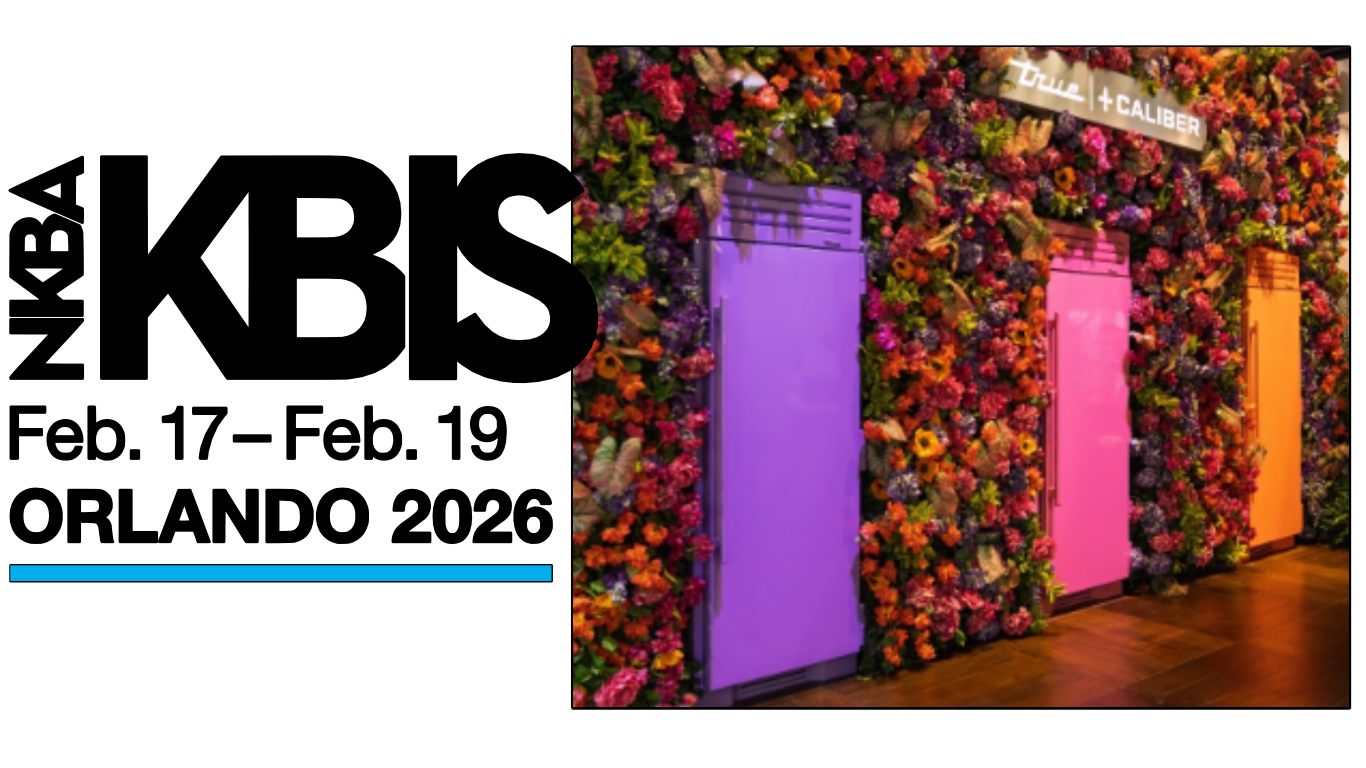
As industry insiders know, the Kitchen & Bath Industry Show (KBIS) is North America’s biggest trade expo dedicated to the multibillion-dollar residential kitchen and bath market. Owned by the National Kitchen & Bath Association, KBIS serves as a key launchpad for new product category design, trends and innovations for today, and tomorrow.
The most recent KBIS show, which recently wrapped up in Orlando, marked a significant milestone for the industry. Co-located with the NAHB International Builders’ Show (IBS) as part of Design & Construction Week (DCW), the combined event drew a record-breaking 117,000 registered industry professionals. Within the KBIS halls specifically, over 650 exhibitors showcased products across nearly 500,000 net square feet of exhibit space.
Who typically attends? The registrant profile is heavily skewed toward the professional market including:
- Designers & Architects: Sourcing high-end fixtures and exploring the latest aesthetic trends.
- Builders & Remodelers: Evaluating technical specifications and installation requirements for luxury projects.
- Kitchen & Bath Dealers & Showroom Managers: Identifying new inventory for professional and consumer clients.
- Distributors & Fabricators: Networking with manufacturers to streamline the supply chain for premium materials.
As the premier Mid-Atlantic wholesale home appliances distributor for home builders, kitchen designers, contractors, and property managers, ADU was at KBIS again this year to work and engage with industry professional and take in the latest design trends and aesthetics across the kitchen and bath industry.
Here are five things we consider key takeaways:
No. 1: Smart Appliances Continue Their Ascent
Smart appliances, such as refrigerators, dishwashers and laundry units, elevate traditional machines by integrating internet connectivity and advanced sensors. Unlike legacy devices that rely on physical buttons and manual operation, smart appliances connect to your home network via Wi-Fi. This allows for remote control, cycle scheduling, and real-time monitoring through smartphone apps. Beyond mere connectivity, they offer enhanced utility, including auto-dosing detergent, energy-usage tracking, and diagnostic alerts that notify you of maintenance issues before they become breakdowns. (We talk about this topic in more detail here: How Smart Builders Future-Proof Multifamily Projects with Flexible Appliance Options).
A few interesting smart models we saw promoted at this year’s show include:
- GE Profile Refrigerator
- GE Monogram Induction Range
- GE Monogram 5-in-1 Oven (with an in-oven camera)
No. 2: Customization is King: Appliances as the Customer Wants
Henry Ford once famously remarked of his low-cost, assembly-line Model T cars that a customer can have any color they want, “as long as it’s black.” Suffice to say, the days of one-size (or-color) fits-all are long gone
At KBIS, product customization is most definitely in, and the resulting choices for buyers are virtually endless. In other words, increasingly with appliances everything is interchangeable: colors, hardware, surfaces. No longer are customers tethered to one look with their oven, for example. So rather than wholesale replacing an entire appliance for a new look in the kitchen, a new oven door color can be swapped out to create a new design aesthetic in the kitchen. The same goes for handles, knobs and other hardware.
A few interesting interchangeable models at this year’s show include:
- True Residential Built-in Refrigeration
- JennAir Built-in Refrigeration
- Café/Rejuvenation Hardware Knobs and Handles
No. 3: The Iceman Cometh: Developments in Freezer Technology
While plenty of new technology has invaded the modern, luxury kitchen over the years, what caught our eye at KBIS 2026: New adventures in ice making. No longer are buyers limited to a single type of standard cube production in their freezer. Rather, newer refrigerators allow for two different types at once including those traditional cubes, but also mini-cubes, crunchable nuggets, crushed, pyramids, even slow-melting solid spheres, the preferred choice by bartenders for select cocktails and spirts to reduce dilution.
Some dual ice makers of note:
- Whirlpool and KitchenAid French Door Refrigerator
- Café side-by-side refrigerator
No. 4: Energy Efficiency Matters + Induction Cooking
Despite some speed bumps of late, the US government’s ENERGY STAR program still exists, though it is currently undergoing a significant transition. The program is moving from the Environmental Protection Agency (EPA), which has overseen it for over three decades, to the Department of Energy (DOE). It also has congressional funding through 2026. That said, appliance energy efficiency is still front and center with appliance manufactures looking to support buyers that want keep their utility bills under control.
One area that’s clear is induction cooking.
Induction cooking has become a new standard in high-end kitchen design, largely due to its superior speed, precision, and efficiency compared to traditional cooking methods.
The fundamental difference lies in how heat is transferred to the food. Traditional gas and electric stoves use conductive or radiant heat. They heat an element (a flame or a metal coil) which then heats your cookware. Much of that energy is lost to the surrounding air, which is why gas kitchens often require high-powered, noisy ventilation.
Induction, however, uses electromagnetism. When you turn on an induction burner, an electric current passes through a coil of copper wire underneath the glass-ceramic surface. This creates a fluctuating magnetic field. When a compatible, ferromagnetic pot or pan is placed on the surface, the magnetic field induces eddy currents inside the metal of the pot itself. This causes the pot to generate its own heat instantly. The glass surface of the cooktop only gets hot via “carry-over” heat from the pot, not the element itself.
Induction cooking advantages of traditional stovetops include:
- Speed and Efficiency: Because the pot generates the heat, induction is incredibly fast. It can bring a large pot of water to a boil significantly faster than gas or traditional electric, and it wastes very little energy heating the surrounding air.
- Precision Control: You can adjust the heat level instantly—from a delicate simmer to a raging boil—with a speed that mimics gas but with the accuracy of a digital interface.
- Safety and Cleanliness: Since the cooktop surface doesn’t get as hot as a radiant electric stove, food spills don’t bake onto the glass, making clean-up simple. Additionally, there is no open flame, which significantly reduces the risk of accidental fires.
- Indoor Air Quality: In the luxury market, “Health-First” homes are a major trend. Unlike gas, induction does not burn fossil fuels indoors, meaning it releases zero combustion byproducts (like carbon monoxide or nitrogen dioxide) into the kitchen
A few interesting induction stovetops include:
No. 5: Great Design Meets Great Construction Has Never Mattered More
Between the turmoil of tariffs, global supply chain challenges, rising costs, and other logistical constraints and disruptions hitting everyone in the industry from appliance makers to home builders, details matter. A lot. For residential construction jobs, such as kitchen remodels, every small delay stemming from errors or missed details means more lost time and growing costs. With these environs, the marriage between great design and construction/installation is more important now than ever where time is literally money.
Working with a partner like ADU can help ensure your kitchen or laundry room are done right (see more on this topic here: Why Appliance Selection Matters in Kitchen and Laundry Design: A Professional’s Guide for Remodelers and Designers). In fact, as we noted before, early appliance planning allows remodelers and designers to:
- Confirm rough-in requirements for electrical, plumbing, and gas
- Ensure proper clearances, door swings, and accessibility
- Coordinate cabinetry, panel-ready appliances, and custom millwork
- Avoid costly rework or appliance substitutions late in the project
Closing Thoughts on This Year’s KBIS
The 2026 Kitchen & Bath Industry Show highlighted an industry prioritizing performance and personalization. From the rise of smart and energy-efficient technologies like induction cooking to advanced ice-making capabilities to the trend of total aesthetic customization, the bar for home design continues to climb. However, as builders and designers navigate today’s increasingly complex logistical challenges, these innovations demand precise, early-stage coordination. Successful projects hinge on the seamless marriage of great design and technical execution. By prioritizing appliance planning with a partner like ADU early in your project or workflow, we can help you mitigate risk, manage costs, and ensure the finished space delivers both form and function for your customers.

