
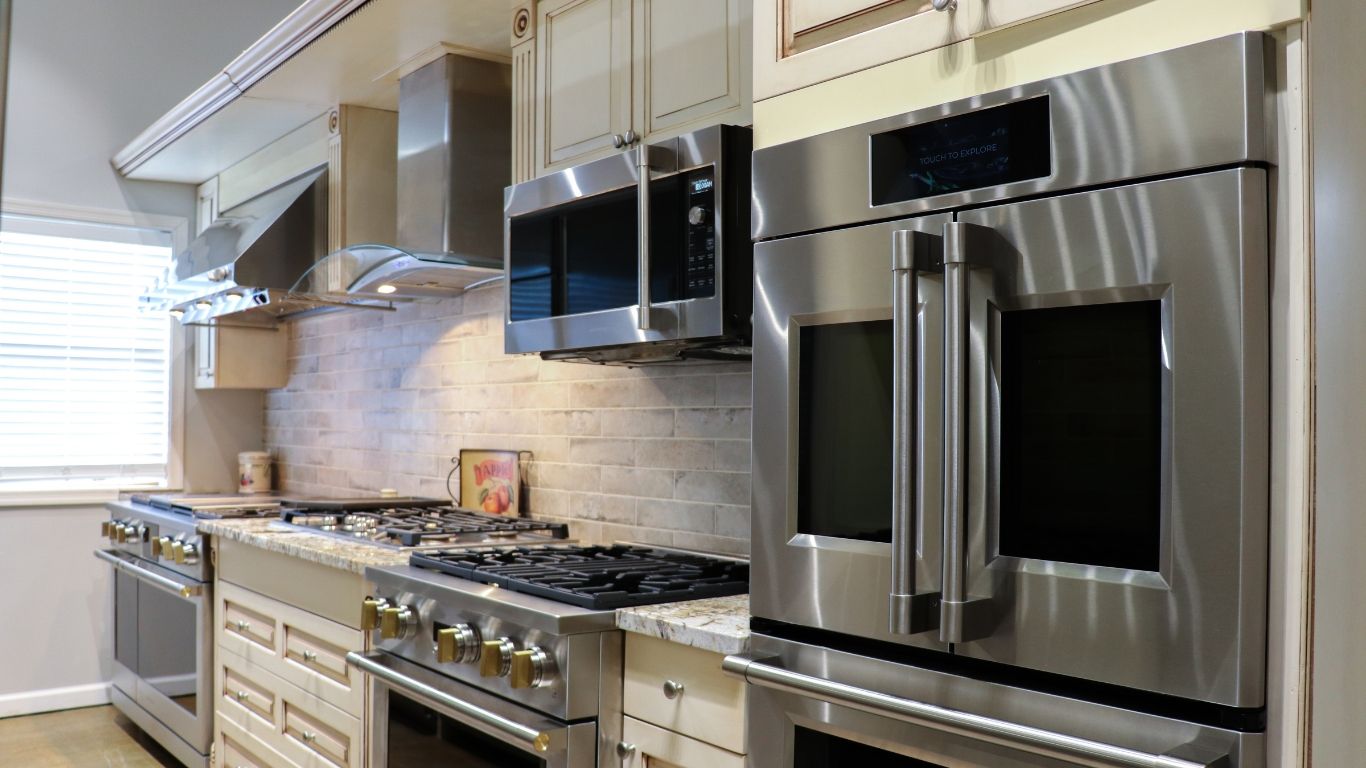
Cooking technology has evolved and today’s luxury homeowners expect their design and build teams to guide them through the nuances of modern oven design and options. From precision steam injection to high-speed convection hybrid systems, understanding how these technologies function, and how they impact kitchen infrastructure, is key to delivering an exceptional project.
What follows is an overview of key oven types and their respective fuel considerations to help professional find the ideal cooking suite for their clients.
Traditional (Radiant / Conventional) Ovens
Overview: A traditional or conventional oven relies on stationary radiant heat emitted from internal heating elements (or burners). Typically, these consist of a lower element for baking and an upper element for broiling. Heat rises naturally, creating temperature zones inside the cavity meaning the top of the oven is naturally warmer than the bottom.
- Fuel Types: Electric, Gas, Liquid Propane (LP).
- Form Factors: Commonly available as standalone Ranges (freestanding or slide-in) and built-in Wall Ovens (single or double configurations).
Key Considerations:
- Highly reliable, simple mechanical controls, and deeply familiar to every homeowner. Excellent for traditional baking (e.g., cakes, soufflés, and quick breads) where gentle, non-circulating heat prevents batter from crusting over prematurely.
- Slower heat distribution; prone to hot and cold spots. Multi-rack baking is inefficient, as pans on the lower rack block heat from reaching the upper levels.
Ideal Use Cases & Specifying Notes
Traditional heat remains a staple in budget-conscious or entry-luxury builder packages. In high-end custom homes, radiant mode is rarely specified as a standalone single-function unit; instead, it serves as a baseline setting within multi-mode electric wall ovens or heavy-duty dual-fuel commercial ranges.
Convection Ovens
Overview: Convection cooking introduces an internal fan system to actively circulate heated air throughout the oven cavity. By breaking down the stagnant boundary layer of cool air that naturally surrounds cold food, convection transfers thermal energy significantly faster than static radiant heat.
Industry-grade luxury ovens feature True European Convection which incorporates a third heating element directly around the fan itself. This ensures that air blown into the cavity is already heated to the exact set temperature.
- Fuel Types: Electric (most common for precise temperature control), Gas, LP.
- Form Factors: Widespread in both built-in Wall Ovens and pro-style Ranges.
Key Considerations:
- Delivers exceptionally even temperature distribution across multiple racks simultaneously. Cooks roughly 25% faster and at approximately 25°F lower temperatures than traditional radiant ovens. Superior for roasting meats, caramelizing vegetables, and achieving crisp, golden-brown pastry crusts.
- The continuous airflow can dry out delicate, liquid-heavy batters or cause rising items (like meringues or light cakes) to tilt if fan speeds are not variable.
Ideal Use Cases & Specifying Notes
True Convection is an industry non-negotiable for serious home cooks, entertainers, and baker-centric kitchens. When designing for high-end clientele, ensure wall oven specs include variable-speed fans or multi-fan systems (such as dual or counter-rotating convection fans) for maximum control.
Steam Ovens & Combination Steam
Overview: Steam ovens cook food using vaporized water. A reservoir (either a refillable manual canister or a direct plumbing line) feeds water into a steam generator, injecting precise moisture into the sealed cavity.
In the luxury market, standalone steam ovens are less common than Combination Steam Ovens which combine steam injection with convection heating elements, allowing cooks to alternate between moist vapor, dry heat, or a combination of both.
- Fuel Types: Electric almost exclusively.
- Form Factors: Primarily built-in Wall Ovens (typically 24-inch or 30-inch trim formats) and specialized cooktop-integrated modules.
Key Considerations:
- Preserves nutrients, moisture, vibrant colors, and original food volume without requiring added oils or fats. Outstanding for reheating leftovers without drying them out. Combination mode allows for restaurant-quality bread crusts (steam for spring, dry heat for crust) and succulent roasts with seared exterior crusts.
- Requires a learning curve for homeowners accustomed to dry-heat cooking. Cavities are generally smaller than standard 30-inch wall ovens. Unplumbed models require frequent water reservoir refills; plumbed models require dedicated water lines and drainage planning.
Ideal Use Cases & Specifying Notes
Combi-steam is currently one of the fastest-growing additions to luxury appliance specs, making it a powerful selling point for custom remodelers and designers.
If specifying a plumbed combi-steam unit, coordinate early with your plumbing team for water line stub-outs and dedicated drain placement behind or below the cabinet cavity.
Speed Cook Ovens
Overview: Speed cook technology is a high-performance hybrid system that combines multiple heat sources—typically true convection heat, radiant broiling elements, and targeted microwave energy—to cook food up to 4 to 8 times faster than a traditional oven without sacrificing texture, crispness, or flavor.
Unlike a standard microwave that simply reheats, a speed cook oven sears, bakes, browns, and roasts while dramatically accelerating total cook time.
- Fuel Types: Electric exclusively (often requiring 208V/240V high-amp electrical hookups).
- Form Factors: Almost exclusively built-in Wall Ovens (often installed as the upper unit in a double-oven or multi-appliance stack).
Key Considerations:
- Unmatched versatility and time efficiency. Can roast a whole chicken in 20 minutes or bake potato wedges in 10 minutes with full browning and crispness. Functions as a secondary full-featured convection oven or a high-end microwave when needed.
- Higher upfront equipment cost. Smaller internal cavity dimensions compared to standard primary wall ovens. Requires client orientation to master pre-programmed auto-cook recipes.
Ideal Use Cases & Specifying Notes
Speed ovens are ideal for busy families, secondary prep kitchens, executive suites, or compact urban luxury layouts where space is at a premium. Specifying a speed oven above a standard 30-inch convection wall oven provides a complete, double-oven workflow without taking up space for a separate microwave.
Microwave Ovens
Overview: Microwave ovens use electromagnetic radiation (magnetrons) to excite water molecules within food, producing rapid heat through dielectric heating. In professional and luxury residential applications, standard countertop units are frequently replaced by integrated Microwave Drawers or Built-In Speed/Sensor Microwaves with matching trim kits.
- Fuel Types: Electric exclusively.
- Form Factors: Built-in Wall Units, under-counter Microwave Drawers, and over-the-range (OTR) combination units (though OTRs are generally avoided in custom luxury design).
Key Considerations:
- Fastest method for boiling liquids, defrosting frozen ingredients, and reheating cooked meals. Inexpensive relative to specialized wall ovens.
- Cannot brown, crisp, or caramelize food. Can create rubbery textures in baked goods and uneven heating spots in dense protein dishes.
Ideal Use Cases & Specifying Notes
Every home needs microwave capability, but luxury design demands hiding or cleanly integrating it.
Under-counter microwave drawers built into island cabinetry or pantry runs keep primary sightlines clean and preserve valuable wall oven stack real estate for steam or speed ovens.
Fuel Types, Utility Planning, and Relative Costs
When guiding clients through appliance selection, utility infrastructure and budget allocation play a major role in determining the final spec sheet.
Gas vs. Electric: The Performance Distinction
- Gas Heat: Gas combustion produces a “moist” heat environment because water vapor is a natural byproduct of burning natural gas or propane. Gas broilers deliver intense direct radiant heat, ideal for searing. However, gas ovens can experience subtle temperature swings as burner valves cycle on and off.
- Electric Heat: Electric elements provide extremely dry, consistent, and controllable heat, making electric the gold standard for baking, convection air management, and low-temperature roasting.
- The Dual-Fuel Solution: For high-end clients who want the best of both worlds, Dual-Fuel Ranges pair a heavy-duty gas cooktop (for instant flame control) with a high-precision electric convection oven underneath.
Electrical & Mechanical Infrastructure Considerations
- Voltage & Amperage: High-performance speed ovens, dual-fuel ranges, and double wall ovens often require dedicated 40-amp to 50-amp, 208/240V circuits. Verify panel capacity early in the framing stage.
- Plumbing & Drainage: Plumbed combi-steam ovens require a cold-water supply line (PRV recommended depending on local water pressure) and high-temperature-resistant drain lines.
- Ventilation: High-output gas ranges or multi-oven stacks generate substantial heat and moisture. Ensure CFM (Cubic Feet per Minute) ratings on ventilation hoods match the total BTU output of the cooking suite to comply with local makeup air codes.
Partnering With ADU
As the Mid-Atlantic’s trusted appliance store since 1982, our dedicated team works directly with builders, designers, architects, and remodelers to make sure projects meet timelines, and budgets.
We provide the details, specs, utility requirements, and live showroom demonstrations to ensure your projects run smoothly from draft to final walkthrough. So, if you’re planning a custom build or kitchen renovation, let’s talk. Contact our team or make an appointment at one of our nine Mid-Atlantic showrooms to find the right oven(s) for your next project.

