
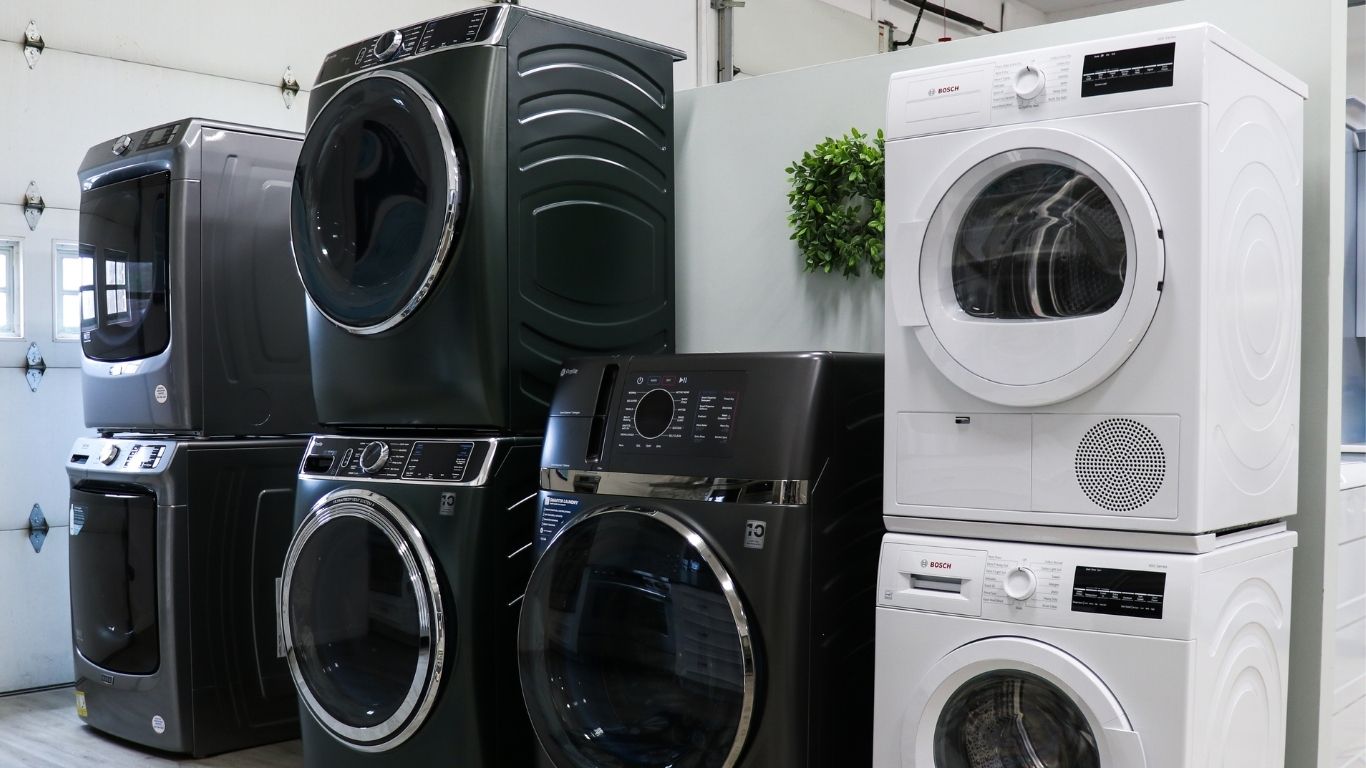
For architects, designers, and builders seeking to maximize usable square footage without compromising high-end amenities, it’s worth exploring all-in-one washer dryer combos.
What Are Washer Dryer Combos?
Washer dryer combos are a single appliance that performs both washing and drying cycles within the same drum. The user loads dirty clothes, selects a wash-and-dry program, and later retrieves clean, dry laundry as quickly as 90 minutes later in some cases all without ever transferring a wet load from one machine to another.
Unlike traditional stacked laundry pairs or laundry centers, which house two distinct mechanical systems in one frame or footprint, these all-in-one combos utilize a unified motor, drum, and condensation or heat pump drying system inside a single standard frame.
Washer-Dryer Combos First Introduced by Bendix in the 1950s
While all-in-one combo units feel like modern technology, the concept dates to the mid-20th century. The first commercial combination washer-dryers were introduced in the United States by Bendix in the 1950s. However, early North American models relied on traditional open-loop vented heating elements that required high electrical loads and complex ducting.
In Europe and Asia, where compact living spaces and higher energy costs are more typical, manufacturers spent decades perfecting ventless closed-loop technology. More recently, the introduction of inverter heat pump technology into all-in-one chassis has transformed the market. Today’s washer dryer combos bear little resemblance to their predecessors; they are quiet, highly energy-efficient, full-capacity machines engineered specifically for modern residential integration.
How the Process Differs from Traditional Standalone Washers & Dryers
Understanding the mechanical differences between traditional pairs and all-in-one units is critical when explaining performance characteristics to clients.
The Washing Process
The wash cycle in a modern combo unit function identically to a premium front-load washer. It uses horizontal drum tumbling, low water volumes, high-speed spin extraction (often exceeding 1,200 to 1,400 RPM), and automated detergent dosing.
The Drying Process
This is where the engineering diverges significantly in the standalone vs. combo washer/dryers:
- Traditional Standalone Dryers (Vented Thermal Exhaust): Draw ambient air, heat it using a gas burner or electric heating element (up to 150°F–175°F), blow it through the wet tumbling clothes, and vent the hot, moisture-laden air directly out of the home through ductwork.
- Combo Washer/Dryers: Modern, Ventless (Using Condensation & Heat Pump): Operates on a closed loop.
- Condensation Drying: Uses cold water or ambient air to chill a condenser coil. Warm, damp air inside the drum passes over the chill plate, causing moisture to condense into water, which drains through the washer drain line.
- Heat Pump Drying: Uses a miniature refrigeration cycle (compressor and refrigerant). It extracts heat from the damp air, condenses the moisture out, reheats the dry air, and recirculates it back into the drum at lower, fabric-safe temperatures (around 120°F–130°F).
Specifying Combo Units vs. Traditional Pairs: Key Technical Differences
When evaluating whether an all-in-one unit fits your floor plan and MEP (Mechanical, Electrical, Plumbing) schedule, consider these primary design and performance parameters:
| Specification Parameter |
Traditional Standalone / Stacked Pair |
All-in-One Washer Dryer Combo Unit |
| Footprint Required |
27″ W × 30″ D × 70-78″ H (Stacked) |
24″-27″ W × 30″ D × 34″-38″ H |
| Venting Infrastructure |
Requires exterior metal duct run |
100% Ventless (No exterior penetration) |
| Electrical Load |
Dedicated 240V / 30A (Dryer) + 120V / 15A (Washer) |
120V / 15A (Heat Pump) or 240V / 30A |
| Water Connections |
Hot/Cold inlets + 2″ Drain Standpipe |
Hot/Cold inlets + 2″ Drain Standpipe |
| Fabric Care Temperature |
Higher heat (150°F+); higher wear risk |
Low-temp heat pump (~120°F); gentler on textiles |
Space Required for Installation
- The Footprint Savings: A stacked 27-inch laundry pair requires a vertical clearance of 72 to 78 inches and dedicated depth clearance for rear ducting. An all-in-one combo cuts vertical space requirements in half.
- Architectural Freedom: Because combo units sit beneath standard 36-inch counter heights, they can be integrated under kitchen islands, built into custom bathroom vanity millwork, tucked under stairs, or concealed inside shallow reach-in closets.
Voltage, Amperage, and Venting Considerations
- Zero Exterior Penetrations: Eliminating exterior dryer vents removes structural penetrations through exterior walls, facades, or rooflines. This preserves envelope air-sealing for Passive House or high-performance green building standards.
- Simplified Electrical Schedule: Many heat-pump all-in-one units operate on a standard 120V / 15-amp dedicated circuit. This eliminates the need for 240V / 30-amp electrical pulls and heavy-gauge wiring in retrofit or ADU projects where panel capacity is limited. (Note: High-capacity commercial-grade combos may still require a 240V supply for rapid water heating).
- Plumbing Requirements: Plumbing requirements remain identical to standard washers: hot and cold supply lines, plus a standard 2-inch drain standpipe or sink discharge setup.
Time Needed to Complete a Load
- Single Load Mechanics: A traditional pair allows parallel processing (Load B washes while Load A dries). A combo unit processes linearly. Total wash-to-dry cycle times for a combo typically can be 90 minutes for some of the “UltraFast” options such as the GE Profile.
- The “Set It and Forget It” Advantage: While a single cycle takes longer, total human intervention time drops to zero. Users do not need to wait around to transfer wet clothes to a dryer to avoid mildew, allowing overnight or work-day automated cycles.
Cost Considerations (Upfront vs. Operational)
- Upfront Purchase & Installation (CapEx): High-end all-in-one heat pump units carry a comparable price point to premium standalone pairs ($1,500 to $2,800). However, the installed cost of a combo is often lower because you eliminate ducting installation, exterior wall caps, and 240V panel upgrades.
- Operational Costs (OpEx): Heat pump combo units are exceptionally energy efficient, using up to 50% to 70% less electricity than traditional resistance-heated dryers. Additionally, because ventless units do not exhaust conditioned indoor air out of the home, they significantly reduce the HVAC heating and cooling load on the building.
Critical Technical Considerations for Trade Professionals
- Lint Management: Traditional dryers vent lint outdoors. Ventless combos capture lint in specialized dual-filter traps or automatically flush lint down the drain line. Ensure your clients understand basic filter maintenance or select models with self-cleaning heat exchangers.
- Capacity Matching: Wash capacity in a combo unit is often higher than its true drying capacity. Overloading the drum reduces airflow around garments and extends drying times. Specify full-size (4.5 to 5.0 cu. ft.) luxury chassis for primary residences.
The Verdict: Where Do Washer/Dryer Combos Fit Best?
All-in-one washer dryer combos are not a universal replacement for every luxury home, but they are an ideal specification choice for:
- Urban Condos & Apartments: Where floor space is at a premium and venting through high-rise curtain walls is cost prohibitive.
- Accessory Dwelling Units (ADUs) & Guest Houses: Where electrical service panels are constrained and floor space must be maximized.
- Primary Suite & Secondary Laundry: Perfect as a secondary unit dedicated to delicates, workout clothes, or primary suite convenience.
- High-Performance & Net-Zero Homes: Where maintaining a tight building envelope without duct penetrations is paramount.
Partnering with ADU for Success
Navigating the nuances of appliance specifications, from heat pump mechanics and electrical loads to door-swing clearances and panel-ready integrations, requires clear foresight during the schematic design phase. That’s why partnering with ADU, is the first stop for well-informed builders, designers, and architects. So, if you’re considering a washer dryer combo, or any other appliance options for your next project, let’s talk! You can also head over to one of our 9 appliance centers/showrooms for expert help from the Mid-Atlantic’s trusted appliance store since 1982.

